
8 Common Myths About Mammograms: What Every Woman Should Know
September 16, 2026
Article Highlights
- Annual mammograms should begin at age 40. Regular screening creates a record of breast health and can help radiologists identify subtle changes, including cancers that may develop between screenings.
- You can develop breast cancer without a family history. Approximately 85% of women diagnosed with breast cancer have no family history.
- Mammograms can detect breast cancer before you feel a lump or notice symptoms. Early detection can lead to more treatment options, less invasive care, and better outcomes.

"No one in my family has breast cancer."
"I don’t feel any lumps in my breast, so I must be fine."
"I'm afraid a mammogram is going to hurt."
"I'm afraid they'll find something."
If you've ever used one of these reasons to put off scheduling a mammogram, you're not alone. For many women, the hardest part of getting a mammogram isn't the appointment itself; it's the fear, anxiety, and uncertainty leading up to it.
It's time to separate fact from fear. Here are 8 common myths about mammograms and what women need to know about taking control of their breast health.
Myth #1: I don't need a mammogram because breast cancer doesn't run in my family.
Fact: Most women diagnosed with breast cancer do not have a family history of the disease.
Your family history is only one part of your breast health story. According to research studies, approximately 85% of women diagnosed with breast cancer have no family history. While having a family history can increase your risk, not having one doesn't mean you can't develop breast cancer. For women at average risk, the American College of Radiology, Society of Breast Imaging, and American Society of Breast Surgeons recommend annual mammograms starting at age 40.
Myth #2: I'm too young to think about breast cancer.
Fact: Your 40s are an important time for breast health.
Your 40th birthday isn't just another number. It can be an important milestone for your breast health.
Breast cancer is more commonly diagnosed in older women, but the incidence begins to rise as women enter their 40s. Breast cancers found in younger women can be more aggressive. That's one reason annual screening beginning at age 40 is so important for women at average risk.
Myth #3: Mammograms are painful.
Fact: A mammogram may be uncomfortable, but the discomfort is temporary.
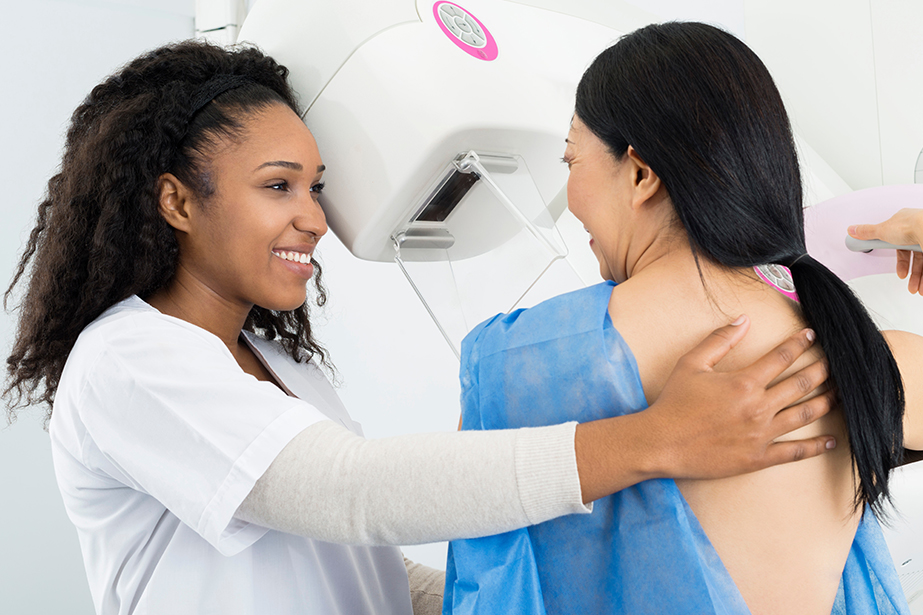
This is one of the most common fears and one of the major reasons women postpone an appointment. During a mammogram, your breast is gently positioned and compressed between imaging surfaces so the radiologist can get clear images of the breast tissue. Compression only lasts long enough to capture the images. Memorial offers the SmartCurve Breast Stabilization System, designed to improve comfort during the exam.
Every woman experiences the procedure differently. Some women describe pressure or brief discomfort, while others find it less uncomfortable than they expected. If you're anxious about pain or discomfort, tell the mammography team before your exam. They can explain what is happening throughout the process and help make you as comfortable as possible.
Myth #4: I'm healthy and don't feel a lump, so I can wait.
Fact: The goal of a screening mammogram is to find breast cancer before you notice symptoms.
Early detection means identifying breast cancer before you feel a lump or notice a change in your breast. By the time something becomes noticeable, cancer may be more advanced.
Your first mammogram also provides an important baseline. It gives your radiologist a picture of your breast tissue that can be compared with future mammograms to identify subtle changes over time. Finding breast cancer early can make a meaningful difference. Studies have shown that when breast cancer is caught early, there can be a 99% survival rate, along with the potential for more treatment options and less invasive care.
Myth #5: I'm afraid they'll find breast cancer.
Fact: Fear of the results shouldn't stop you from getting information that could help protect you.
This may be the most understandable fear of all. Getting a mammogram doesn't make a problem appear. It simply allows you and your healthcare team to find something that may already be there, ideally as early as possible.
And finding something doesn't automatically mean you have breast cancer. Sometimes additional imaging is needed to get a clearer look at an area of breast tissue. If breast cancer is found, detecting it early can mean more treatment options and better outcomes. Advanced technologies, like 3D mammograms, can help detect very small cancers, including cancers at stage 0 before they have had a chance to spread.
Myth #6: I had my first mammogram, I don’t need another one.
Fact: Annual mammograms allow radiologists to monitor changes over time.
Think of your first mammogram as the beginning of an ongoing record of your breast health. Your baseline mammogram can be used for comparison during future screenings. Annual imaging allows radiologists to look for subtle changes from year to year.
Consistency matters because some breast cancers can develop and spread within a year. Missing a screening could delay detection and allow cancer to progress before it is found. Making your mammogram an annual routine can provide peace of mind and help ensure that changes are identified as early as possible.
Myth #7: Mammograms don't find cancer until it's already advanced.
Fact: Mammograms are designed to detect breast cancer early, even before symptoms develop.
The goal of a mammogram isn't simply to find cancer. It's to find it as early as possible. Advances in breast imaging are making early detection more precise. For example, 3D mammography can provide radiologists with more than 60 detailed images of breast tissue.
Memorial Healthcare System’s partnership with Solis Mammography allows patients to get a 3D mammogram that uses artificial intelligence to support breast cancer detection, which may increase early detection of invasive breast cancer and reduce the need to recall a patient to repeat an imaging test. These technologies can help radiologists identify very small cancers.
Myth #8: If I have dense breasts, a mammogram won't help detect cancer.
Fact: Your first mammogram can provide important information about your breast tissue, including breast density.
Your mammogram does more than look for signs of cancer. It can also help determine your breast density. Women with dense breasts have a higher lifetime risk of developing breast cancer. Understanding your breast density gives you and your healthcare provider important information to consider when discussing your ongoing breast health and screening needs.
As you think about whether you should get a mammogram, consider a different way to think about it. Instead of seeing it as an appointment you dread, see it as an act of self-care, a few moments set aside to protect your future.
Our imaging centers offer low-dose 3D mammograms. Schedule one today.
855-530-2383 Schedule a Screening Mammogram Online


Related Providers
-

 Erica Bloomquist, MD Breast Surgical Oncology
 -
 Alejandra Ergle, MD Breast Medical Oncology
 -
 Adriana Milillo Naraine, MD Breast Medical Oncology
 -
 Aretha Nelson-Casimir, MD Breast Medical, Internal Medicine
 -
 Esther Ozeryansky, MD Breast Surgical Oncology
 -
 Heather Wright, MD Breast Surgical Oncology
 -
 Jennifer Zikria, MD Hematology & Oncology